A. Andrew Gonzalez

This Website is Best Viewed Using Firefox

Visionary Religious Art & Nudes:

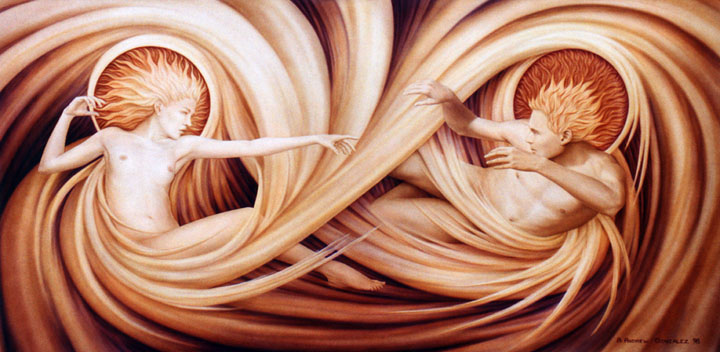
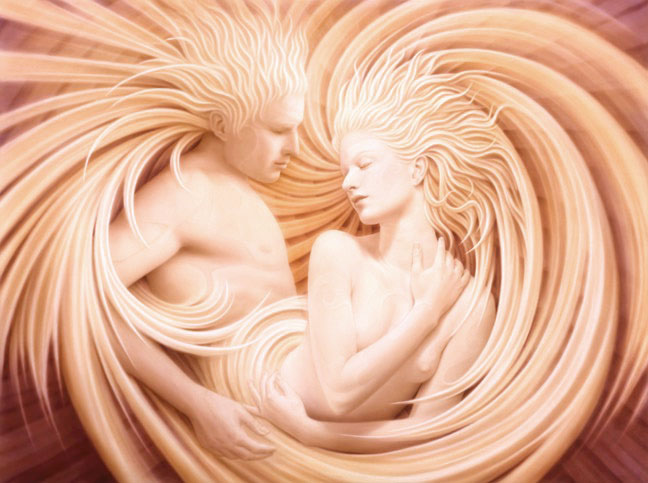
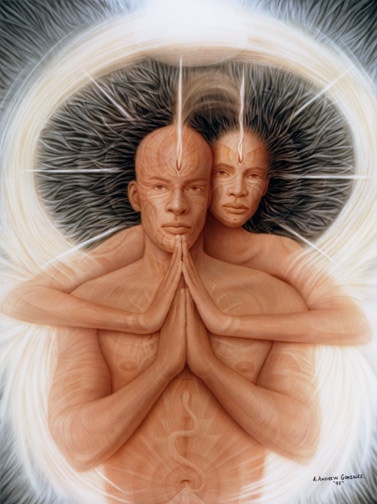
A. Andrew Gonzalez (Born October 13, 1963) is an award-winning figurative artist whose work has been exhibited worldwide. His artist father, Anthony A. Gonzalez, encouraged his early interest in drawing and painting, but gave him no formal training. His painting style and topic are inspired by William Blake's The Whirlwind of Lovers: Paolo and Francesca.

Michelangelo, the Italian renaissance artist, preferred sculputure to painting, because sculpture allowed him to simply reveal the form already hidden within the stone. Thus, sculpture can be seen as a subtractive process, whereas painting is typically an additive process.

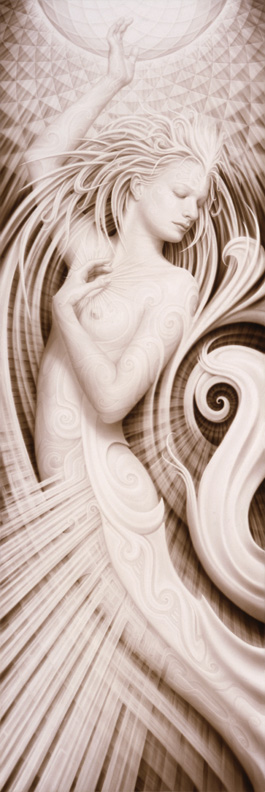
Gonzalez turns this on its head. He achieves a sculptural look by airbrushing acrylics onto gesso panels, then lifting pigment with an abrasive eraser. This is followed by the application of transparent layers of paint. In darker sections, he may repeat these steps many times over. Claybord provides the best surface for this technique, but on rare occasion, the artist will use canvas.

Each meticulously crafted painting can take many months to complete. The level of detail often requires Gonzalez to wear a magnifiying visor. His final pieces are a combination of pre-planned and spontaneous forms, the latter discovered as his eraser technique reveals hidden designs.

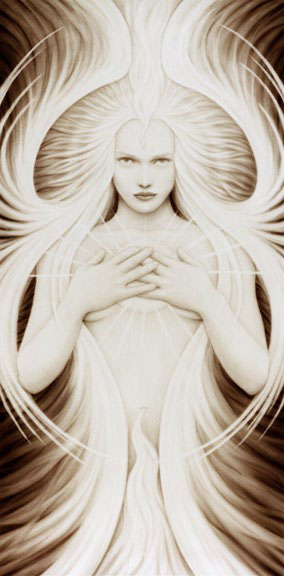
Influenced by idealism in the Mystical, Visionary and Esoteric traditions, the artist describes his work as a contemporary Tantric or Transfigurative art that explores the dramatic union of the sensual and spiritual. His work is akin to a revival of classical Neoplatonic ideals centering on the figure as both temple and vessel, sublimed by transformative forces. His best known piece is Unio Mystica

Gonzalez's work has been featured in books ('Drinking Lightning', 'Eyes of the Soul', 'Aphrodisia: Art of the Female Form', Metamorphosis...), magazines (Contour, MAPS, Gnosis...) and on album covers, (Xyra & Verborgen, Mark Dwane, Voidgazer...). It's been showcased at Burning Man, the Interdimensional Art Show, Synergenesis and many other venues. Some of the more unusual places his art can be found are the Galactik Trading Cards series and in numerous tattoos.

Gonzalez's art has also been mentioned in a number of articles and essays that delve more deeply into the philosophies it derives from. These include 'Flowing Light: The Angelic Art of A. Andrew Gonzalez' by Daniel Mirante and 'What Is Visionary Art?' by Alex Grey.

  • Alchemico d'Amore
  • Anima Sublimis
  • Aura Gloriae
  • Crescendo of the Heart
  • Fravashi
  • Genii
  • In the Wake of the Underground Sun
  • Luminae
  • Magia of the Heart
  • Mayas Dream
  • Melusina
  • Manna Stone
  • Mesmerize
  • Messenger
  • Nekyia
  • Pandora
  • Passion
  • Persephone
  • Saltatus Aeternum
  • Sapientia
  • Seraphim Awakening
  • Shakti
  • Soror Mystica
  • Telluric Womb
  • The Angel of Nekyia
  • The Breath of Dakini
  • The Golden Dakini
  • The Kore
  • The Logos
  • The Love of Souls
  • The Oracle of the Pearl
  • The Sacred Marriage
  • The Secret Rapture
  • The Siren's Dream
  • The Source
  • The Summoning of the Muse
  • The Visitation
  • Unio Mystica
  • Xvarnah
  • Yemanja/The Awakening of the Heart

  • Flowing Light - The Angelic Art of A. Andrew Gonzalez
    Daniel Mirante

    "The divine seeing itself in the mirror is beauty, and you are the divine and you are the mirror."

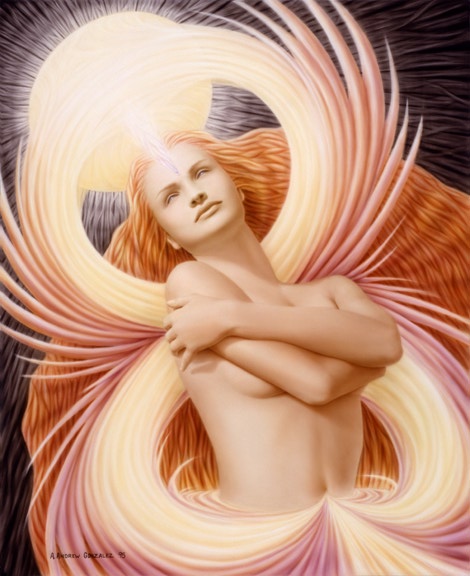
    A. Andrew Gonzalez, of San Antonio, Texas, has been depicting the human form "as temple and vessel sublimed by transformative forces" for over 15 years. Empowered by an artistic mission to "transform the collective imagination", Gonzalez wields with masterly sensitivity the evanescent medium of airbrush and acrylic, and succeeds in bringing forth images of the profound, heart-piercing tenderness of the angelic encounter with what he calls the "transfiguring biosophic flame".

    Hyperdimensional Consciousness

    We are hyper-dimensional beings. We are already spirit, we are already enlightened, we are already self-existent, non-compounded light. We are already in the spirit realm. We are already creating the dreams of God, we are already beautiful, primordial, divine and in the condition of Eternal Life.

    The divine creative force, drips crystal fire from every centre, radiating through a divine spectrum of archetypal, angelic, solar and planetary formations. All manifest creation and life is the face of God, the surface emination, looking outward upon itself. The universe is the flow of Infinite Spirit, and its magic is the play, the Lila, of God.

    The divine spun Gaia as a vale of soul making and of existence and experience. It is a fecund and miraculous garden of chthonic, chlorophylic, mineralogical, cultural and psychosexual play. We are children of a cosmos that created us and has been watching. As we procrastinate and doubt, rationalise and persue small-time agendas, it has watched, in every leaf, in every cell, registering and understanding its Lila.

    Angelic Phenomena

    During the visionary state, the transpersonal condition, the "centre that is free" – the free-state human energy condition - we encounter constellations of energy/information that sometimes become personified. These are the entities spoken of in the shamanic vision quest ; the earth elementals, the ancestors, the angels, demons and planetary avatars.

    Angels are manifestations of Logos – divine messengers and healers, performing unfathomable illuminating and redemptive functions within the celestial and terrestrial matrix. Winged and resplendent, angels pursue the shadows of ignorance and darkness, shining, like the sun, without preference, nurturing love upon the most humble of beings, helping them to transcend their limitations. Angels help the soul to hatch out of its enclosure, its psychic shell of recursive behavior patterns and cycles. A true light pierces the encrustations around the heart and this is the beginning of a turning, a deep reorientation, from someone who looks at the past and regrets, to a reborn one who faces the future and the light. This heart-opening epiphany is the theme depicted in many of Andrew Gonzalez images.

    In times of secular materialism, it is rare that we have the eyes to see this serendipity. That is why it is good to have paintings such as these, to remind us of celestial mercy that overwhelms consciousness with its lightness, highness and purity. Andrew Gonzalez describes one such experience, as being "enveloped in a fiercely radiant golden light, moving rapidly towards its blazing white centre. I felt what could only be described as a sense of being reborn”. The sweet ambrosia of the Great Spirit removes blockages and opens up sacred centers in the body that transmit and receive spiritual light. This transfiguration is the remedy to self-persecution and existential angst.

    The images brought into being by Gonzalez depict both the orientation to and embodiment of the biosophic energies of celestial grace and force. In that light, we are endlessly purified, fresh and new, ever renewing, ever-resurrected and upheld in spirit by the power of the celestial. We are as delicate as blades of grass, fresh and jeweled with the elements, nothing holding us up, eternal and precious in the moment. And that Sun that we behold, the celestial light that showers its life-imbuing force upon us, is nothing less than our own true nature, where we came from, and where we are coming from every moment. It is what we are, underneath the Lila-Samsara, or ‘Satanic Deception’ of the contemporary deranged mind.

    Entering into that light is the end of psychic story time, and the beginning of Reality. It is the jeweled epiphany of divine life. It is Eternity. The cherubim and seraphim, the dakini messengers, mysterious personifications of our own light too bright for us to identify with, are our higher centers - dissociated, yet coming into communication, to raise our frequency into a fullness of being, where we radiate from every dimension, not just from our ego and emotions.

    Through this work - a work of alignment - the passage of higher energies is created, opening the connection between Earth and the Universal Life of the Celestial. In time even the most lost atoms of mind will discover in the innermost centre of its constituent nature the indivisible light, that oneness, which shares in the indestructible purity of the Whole.

    The Angelic dakini moving through the celestial, and through Gonzalez magical paintings, tell us we are more than what we know, so we move into serving and living for more than what we think we are, and teaching us to give thanks to the glories that are and forever will be in the eternal garden of the Heart.


    Have a lot of friends that do all that it takes to stay up on today's new looks, fads, and fashions? Are you one of those people that spend  endless hours in the gym in hopes to yield amazing results for your body? Interested in finding out more about Cosmetic Surgery? Do you have an upcoming procedure scheduled that you want to learn more about? Procedure such as breast augmentation require the best professionals to get the results you want, so make sure you get yourself the best cosmetic surgeon available. Get that perfect body that you have been dreaming of and find out how at Plastic Surgery Portal.

    What Is Visionary Art?
    Alex Grey

    The artist's mission is to make the soul perceptible. Our scientific, materialist culture trains us to develop the eyes of outer perception. Visionary art encourages the development of our inner sight. To find the visionary realm, we use the intuitive inner eye: The eye of contemplation; the eye of the soul. All the inspiring ideas we have as artists originate here.

    The visionary realm embraces the entire spectrum of imaginal spaces – from heaven to hell, from the infinitude of forms to formless voids. The psychologist James Hillman calls it the imaginal realm. Poet William Blake called it the divine imagination. The aborigines call it the dreamtime; and Sufis call it alam al-mithal. To Plato, this was the realm of the ideal archetypes. The Tibetans call it the sambhogakaya – the dimension of inner richness. Theosophists refer to the astral, mental, and nirvanic planes of consciousness. Carl Jung knew this realm as the collective symbolic unconscious. Whatever we choose to call it, the visionary realm is the space we visit during dreams and altered or heightened states of consciousness.

    Every sacred art tradition begins with the visionary. "Divine canons of proportion," mystic syllables, and sacred writing were all realized when the early wisdom masters and artists received the original archetypes through visionary contact with the divine ground. After a sacred archetype has been given form as a work of art, it can act as a focal point of devotional energy. The artwork becomes a way for viewers to access or worship the associated transcendental domain. In sacred art, from calligraphy to icons, the work itself is a medium: a point of contact between the spiritual and material realms.

    The Role of Art

    Our inner world – the life of our imagination with its intense feelings, fears, and loves – guides our intentions and actions in the world. Our inner world is the only true source of meaning and purpose we have. Art is the song of this inner life. Art’s key role in the human drama is that of a "great convincer." The artist posits one myth, religion, or ideology over another, yet also always expresses the raw passion and evolutionary force of the inner world itself. v The artist attempts to make inner truths visible, audible, or sensible in some way, by manifesting them in the external, material world (through drawing, painting, song, etc.). To produce their finest works, artists lose themselves in the flow of creation from their inner worlds. The visionary artist creatively expresses her or his personal glimpses of the Divine Imagination.

    Every work of art embodies the vision of its creator and simultaneously reveals a facet of the collective mind. Art history shows each successive wave of vision flowing through the world's artists. Artists offer the world the pain and beauty of their souls as a gift to open the eyes of the collective and heal it. Our exposure to technological innovations and diverse forms of sacred art gives artists at the dawn of the twenty-first century a unique opportunity to create more integrative and universal spiritual art than ever before.

    The Visionary Tradition

    A complete historical account of the global visionary art tradition would fill volumes. The sixteen thousand-year-old cave paintings of human/animal hybrids, such as the Sorcerer of Trois Freres, are a good starting point. Much ancient shamanic art, such as African ritual masks and aboriginal rock and bark paintings, clearly depict visionary dreamtime wanderings and encounters in the lower and upper worlds. A visionary art history lesson would include representations of mythic deities and demons: the Mayan feathered serpent; Egyptian and Greek sphinxes; and Indian, Balinese, and Thai portrayals of many-limbed, many-headed beings housed in complex mandalas.

    One of the earliest known Western mystic visionary artists was Hildegard of Bingen, a twelfth-century German abbess. While enveloped by a fiery inner light, she was told to "speak and write not according to human speech or human inventiveness, but to the extent that you see and hear those things in the heavens above in the marvelousness of God." The icons created from her visions are direct and authentic gifts of spirit.

    Perhaps the most famous visionary artist was the fifteenth-century painter Hieronymous Bosch, who portrayed an extraordinary array of grotesque beings, tortured souls in hell, and angels guiding the saved to the light of heaven. His Garden of Delights is one of the strangest paintings in the world – an encyclopedia of metamorphic plant/animal/human symbolism. Pieter Bruegel was touched with the same visionary madness when he created Fall of the Rebel Angels and Triumph of Death – an amazing landscape featuring a coffin go-kart and armies of skeletons herding the struggling masses. Northern and Italian Renaissance artists like Grunewald, Durer, and Michelangelo delineated the revelations of Christian mysticism with searing, Gothic realism.

    Our historical sketch of visionary art would have to include the seventeenth-century alchemical engravings of Johann Daniel Mylius and mystics like Jacob Boehme and Robert Fludd, who detailed complex mandalic philosophical maps pointing to union with the divine.

    William Blake, the nineteenth-century mystic artist and poet, conversed with angels and received painting instructions from discarnate entities. Blake published his own books of art and poetry, which revealed an idiosyncratic mysticism arising from his inner perception of religious subjects. He resisted conventional religious dogma, proclaiming that "all religions are one." The characters in Blake's paintings and engravings seem akin to those of Renaissance masters Michelangelo, Raphael, and Durer – yet are softened with a peculiar magic. His artwork exalts an ideal realm of inspiration that he termed the "divine imagination." Blake's work laid the foundations for the nineteenth-century Symbolist movement that included such artists as Gustav Moreau, Odilon Redon, Jean Delville, and Frantisek Kupka.

    The realm of visionary art also embraces Modernist Abstraction like the works of Kupka, Klee, and Kandinsky; Surrealist or Fantastic Realist art; and Idealist work like Blake's. The twentieth-century Surrealists operated in a territory without clear moral order: a dreamship adrift on the ocean of the unconscious. Artists like Max Ernst, Salvador Dali, Hans Arp, Hans Bellmer, Stanislav Szukalski, Juan Miro, Leonora Carrington, Remedios Varo, and Frida Kahlo mixed images from childhood memories, adult desires and fears, sex and violence – wherever the creative currents led them. The visions of the Surrealists help to define a dream realm where any bizarre juxtaposition is possible. A profound truth resides in such strangeness, for these visions can shock us into deepening our acknowledgement and appreciation of the Great Mystery.

    The Russian painter Pavel Tchelitchew was one of the great visionary artists of the twentieth century (his obsession with anatomy and mysticism relates to my own work). Tchelitchew's paintings evolved through metamorphic symbolism to x-ray anatomical figures glowing with inner light, and eventually progressed to luminous, abstract networks.

    Perhaps the most widely respected visionary painter of the twentieth century is Ernst Fuchs, whose highly detailed and symbolic works are often based on biblical and mythological subjects. Fuchs combines the technical mastery of Durer and Van Eyck with the imagination of Bosch and Blake in a completely personal fantastic realism. Fuchs has had a widespread and profound influence on many of the greatest contemporary visionary artists. The masterful Mati Klarwein, Robert Venosa, De Es Schwertberger, Olga Spiegel, Philip Rubinov-Jacobson, and many others count him a key teacher or inspirational force.

    The post-World War II Vienna school of Fantastic Realism included artist friends of Ernst Fuchs, like Arik Brauer, Anton Lehmdon, Wolfgang Hutter, and Rudolph Hausner. In 1940s America, the artists Ivan Albright, George Tooker, Paul Cadmus, Peter Blume, and Hyman Bloom were known as Magic Realist painters.

    The psychedelic sixties spawned a new kind of poster art, leading many painters in a visionary direction. In the 1960s and 70s, a loosely associated group of California visionary painters – Joseph Parker, Cliff McReynolds, Clayton Anderson, Gage Taylor, Nick Hyde, Thomas Akawie, Bill Martin, and Sheila Rose – were published by Pomegranate Art Books. Pomegranate has also featured the shamanically inspired work of Susan Seddon Boulet. A more visually aggressive psychedelic pop surrealism energizes the work of Keith Haring, Kenny Scharf, and Robert Williams.

    Paul Laffoley, a painter and architect, is one of the most encyclopedic of visionary geniuses. Dystopic visions of contemporary hell worlds are stunningly portrayed in the paintings of Joe Coleman, H.R. Giger, Manuel Ocampo, and Odd Nerdrum. Visionary abstraction is articulated in beautiful infinities in the works of Allyson Grey, Bernie Maisner, and Suzanne Williams.

    Some of the most promising new visionary painting is by A. Andrew Gonzalez, Erial, and Guy Aichison. The archetypal mindscapes of Francesco Clemente and Ann McCoy enjoy the rare distinction of visibility and success in the contemporary art marketplace. The word "visionary" has also come to be associated with "outsider, naive, insane, and self-taught" artists, who include Adolph Wolfli, Reverend Finster, and Minnie Evans.

    What unites these various groups of artists is the driving force and source of their art: their unconventionally intense imaginations. Their gift to the world is to reveal "in minute particulars," as Blake would say, the full spectrum of the vast visionary dimensions of the mind.

    This site is a member of WebRing.
    To browse visit Here.
    Click Here to Join some Webrings